The fastest way to raise Confidence in Horses of Hoofprint Bay is Confidence Training, because you can repeat it in the same day. A run takes under a minute, costs 2 exercise and can add up to 10 Confidence. Just stop before the red marker on the exercise bar. Add 10 scritches and 10 treats, and a horse can climb most of the bar in a single day.
Your library’s Confidence book explains the idea. The numbers below are what it leaves out.
What Confidence changes
The bar has two markers, at 33 and 80. The higher a horse sits, the less work it is to ride.
| Confidence | Presses to change speed | Changes speed by itself |
|---|---|---|
| 33 or lower | 2 or 3 | Every 4 to 10 seconds |
| 34 to 80 | 1 or 2 | Every 4 to 18 seconds |
| 81 to 97 | 1 | Every 5 to 22 seconds |
| 98 to 100 | 1 | Never |
Below 33, riding gets risky. Each jump has a 30% chance of being refused, and the horse can stop dead when it would normally just change speed. Sort that out before you enter a jumping course.
The 98 line doesn’t apply to Rebellious, Energetic or Chill horses, who keep changing speed however confident they are. The Traits and Quirks guide explains how each one behaves.
A foal starts with half its mother’s Confidence on the day she’s covered, so raise hers first if you’re planning to breed. The Breeding guide has the rest.
Riding lessons
Every lesson needs a minimum Confidence, and the numbers run backwards. Beginner, the children’s lesson, asks for the most.
| Lesson | Confidence | Strength | Endurance |
|---|---|---|---|
| Beginner | 80 | 15 | 10 |
| Novice | 70 | 20 | 12 |
| Intermediate | 60 | 40 | 30 |
| Advanced | 50 | 70 | 50 |
Scary objects
Every scary object has a rating, and what a horse does depends on how far its Confidence sits above that number.
| Confidence above the rating | What the horse does |
|---|---|
| 0 or less | Slows to a walk, then stops to look |
| 1 to 10 | Walks past |
| 11 to 20 | Trots past at most |
| 21 to 30 | Canters past at most |
| More than 30 | Passes at any speed |
| Object | Rating |
|---|---|
| Umbrella | 40 |
| Plastic Bag | 60 |
| Pool Noodles | 80 |
| Bridge | 80 |
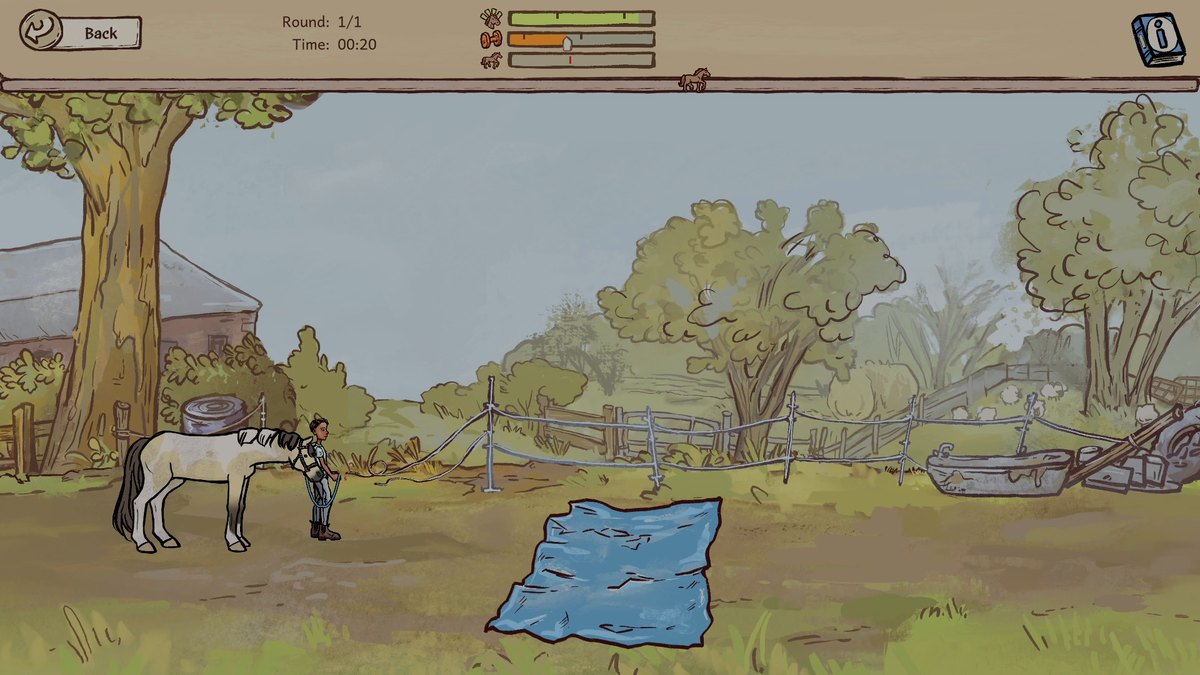
| Tarp | 100 |
So even a horse at 100 only trots over a bridge, and nothing makes it relaxed about the Tarp.
The fastest way to raise it
Scritches and treats
Below the upper marker, 10 scritches and 10 treats give a horse an easy 20 Confidence a day. Aquila went from 40 to 60 this way. Stop at 10 treats, because the next one blocks scritches until tomorrow. Ten treats also add 20 body condition, so go easy on a horse that’s already heavy.
Both stop working at the upper marker. Scritches are the free half of this, and the petting guide shows how to find the itchy spot.
Confidence Training
This is the big one. Open Exercise in the stable, choose Train, and scroll down to Confidence Training 1 or 2. You lead the horse on foot past two scary objects.
- Walk towards the object until the horse lowers its head and stretches its neck to look. That’s Curious.
- Press Praise, which is S by default. Each praise while it’s Curious earns Confidence and lets you get closer.
- If its head comes up and it tenses, that’s Worried. Press Back up, which is A by default, and give it space. Keep pushing and it’ll turn and bolt.
- Walk it past the object.
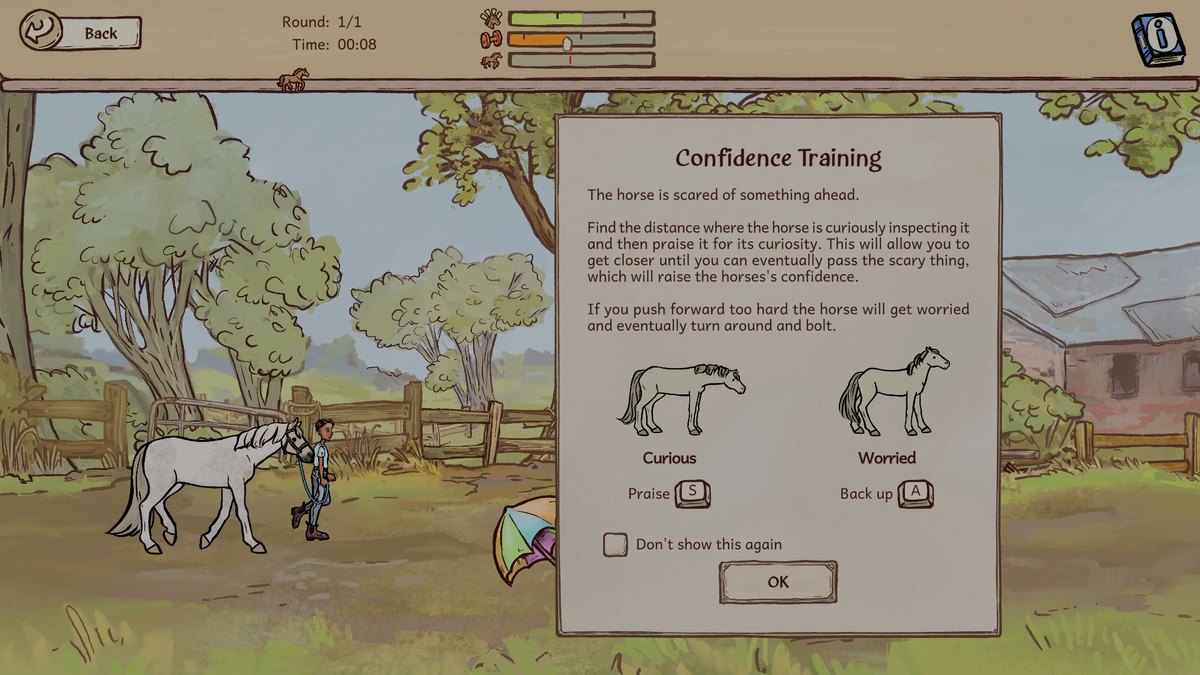
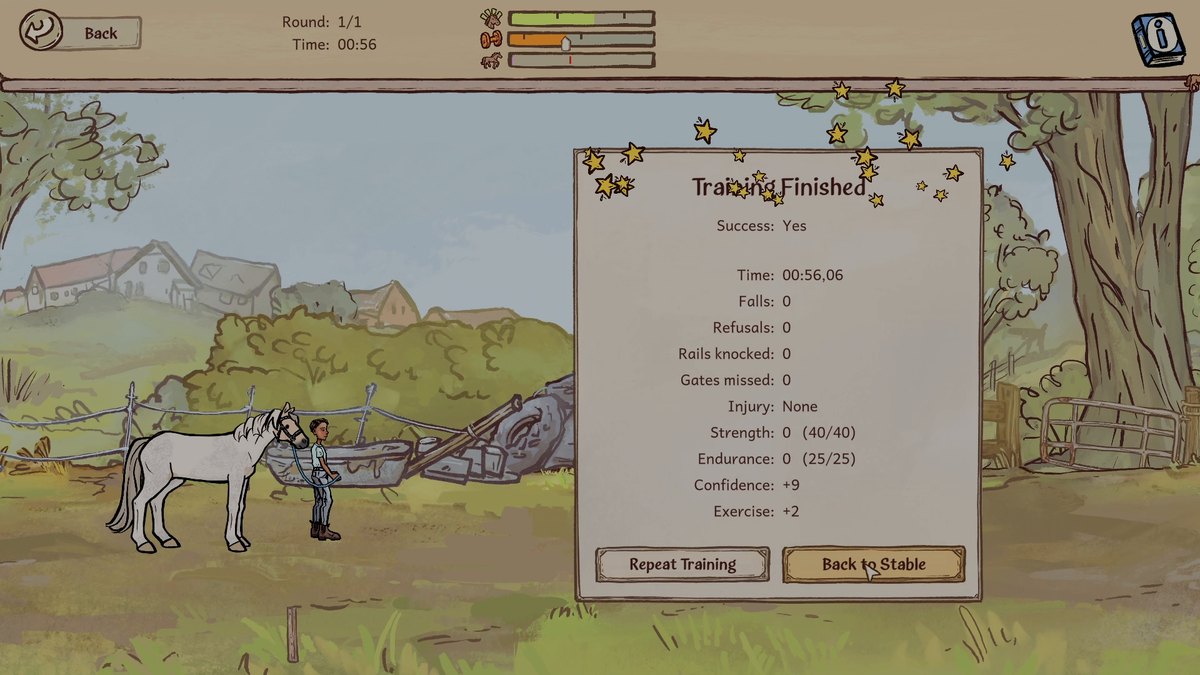
You collect the Confidence once you’re past: 1 for each praise, up to 5 per object. With two objects, that’s up to 10 a run.
The results screen then offers Repeat Training, so you can go again straight away. Princess went from 50 to 59 on her first run and reached 64 on her second, for just 2 exercise a time.
| Course | Objects | Use it for |
|---|---|---|
| Confidence Training 1 | Umbrella, Plastic Bag | Horses below about 60 |
| Confidence Training 2 | Pool Noodles, Tarp | Everything above that, right up to 100 |
How many runs a day
Stop before the red marker on the exercise bar. Ride past it and the horse is exhausted the next day: weaker, with a lower exercise limit, and unable to gain strength or endurance until it recovers. Go past the marker again while it’s exhausted and you risk a tendon injury, which stops it being ridden at all. The game warns you with Exhaustion possible when a course would take it over.
| Endurance | Exercise a day | Confidence Training runs |
|---|---|---|
| 10 | 16 | 8 |
| 20 | 35 | 17 |
| 30 | 49 | 24 |
| 50 | 71 | 35 |
Those runs assume the horse has done nothing else that day. Everything counts towards the limit, so one run of Cavaletti Training uses 12 by itself, and a night in the fields adds a little too. Yearlings have lower limits, at 15 for 10 endurance and 27 for 20.
Each point of exercise also costs 1 body condition. That won’t stop you riding, but a long session adds up, so feed grain and keep an eye on the gauge. A hungry horse can still be ridden, and a malnourished one can’t.
Which horses can do it
A very confident horse stops noticing the Umbrella, so there’s less to gain from the first course as it climbs. Confidence Training doesn’t build strength or endurance, so it won’t replace normal work. Yearlings and nursing mares can do it, which makes it an easy way to bring on young stock. Heavily pregnant mares and Explosive horses can’t.
Riding
Everything here takes Confidence past the upper marker, but it’s slower. Most of these are only a 50% chance of +1, so a clean run of Cavaletti Training usually adds 1 to 5.
| Action | Gain |
|---|---|
| Clear a jump | 50% chance of +1 |
| Pass a gait gate in the right gait | 50% chance of +1 |
| Praise within a second of a speed change you asked for | 50% chance of +1, at most every 3 seconds |
| Correct the horse while the warning arrows show | 50% chance of +1, and it stays at your speed |
Correcting works the same way as the warning arrows in the Traits and Quirks guide: press the opposite direction before the change happens.
Staff can’t do any of this for you, because their training doesn’t touch Confidence.
What costs Confidence
| What happened | Loss |
|---|---|
| A new day | 1 |
| Wrong gait at a gait gate | 1 |
| Refusal because Confidence is below 33 | 1 |
| Knocked rail | 2 |
| Fall after knocking a rail | 3 |
| Running into a jump | 4 |
| Fall on a solid obstacle | 6 |
| Jumping with too little strength | 10 |
| Jumping a big obstacle from a walk | 10 |
Those last two are the ones to avoid. They cost more than a whole run of Confidence Training can give back, so check a horse’s strength before you ask it to jump.
One run can’t add more than 10 Confidence or take away more than 15, however it goes. The limits apply per run, which is why repeating short runs works so well.
Daily loss is the slow one. A horse kept at 98 or above needs a little work every day to stay there, so a quick run of Confidence Training 2 is the easiest way to hold it.