In Horses of Hoofprint Bay, a foal takes 20 days to go from cover to adult, and its potential is the average of its parents plus a random roll. Three things decide how well breeding goes for you: keep stallions out of your mares’ stable group, pick unrelated parents with high potential, and feed your mare through the second half of her pregnancy.
Your library’s Breeding book explains the basics. The numbers below are what it leaves out.
How to get a mare pregnant
There are four ways, and the first two always work.
| Method | What you need | Cost per try | Chance |
|---|---|---|---|
| Breeder in town | Parking Lot, for the trailer | Stud fee | 100% |
| Cover Mare at home | Breeding Station and your own stallion | Free | 100% |
| Fresh semen | Breeding Station stage 2 | 10 coins | 85% |
| Frozen semen | Breeding Station stage 3 | 20 coins | 70% |
The town breeder is the cheapest way to start, as long as you’ve built the 200 coin Parking Lot, since you can’t reach the breeder without a trailer. A stud fee is 100 coins plus a bit more for potential and prize money, so the stallions on offer early in the game cost just over 100 coins.
| Stallion’s combined potential | Stud fee |
|---|---|
| 50 | 103 |
| 100 | 117 |
| 150 | 158 |
| 180 | 214 |
| 200 | 310 |
Prize money adds 1% of the stallion’s winnings on top. Combined potential is strength potential plus endurance potential.
Both horses need to be fit to ride, and neither can have bred or competed that day. Age matters too: a horse can only breed from 12 days old until it turns 180. A mare with a foal at her side can be covered, though, so she doesn’t have to wait until the foal grows up.
The Breeding Station
Build it once you want to use your own stallion, because every cover after that is free.
| Stage | Cost | Running cost per day | Build time | Unlocks |
|---|---|---|---|---|
| 1 | 1,500 | 15 | 2 days | Cover your own mares and customers’ mares |
| 2 | 5,000 | 40 | 3 days | Take Semen, fresh semen and the Lab |
| 3 | 15,000 | 100 | 5 days | Frozen semen |
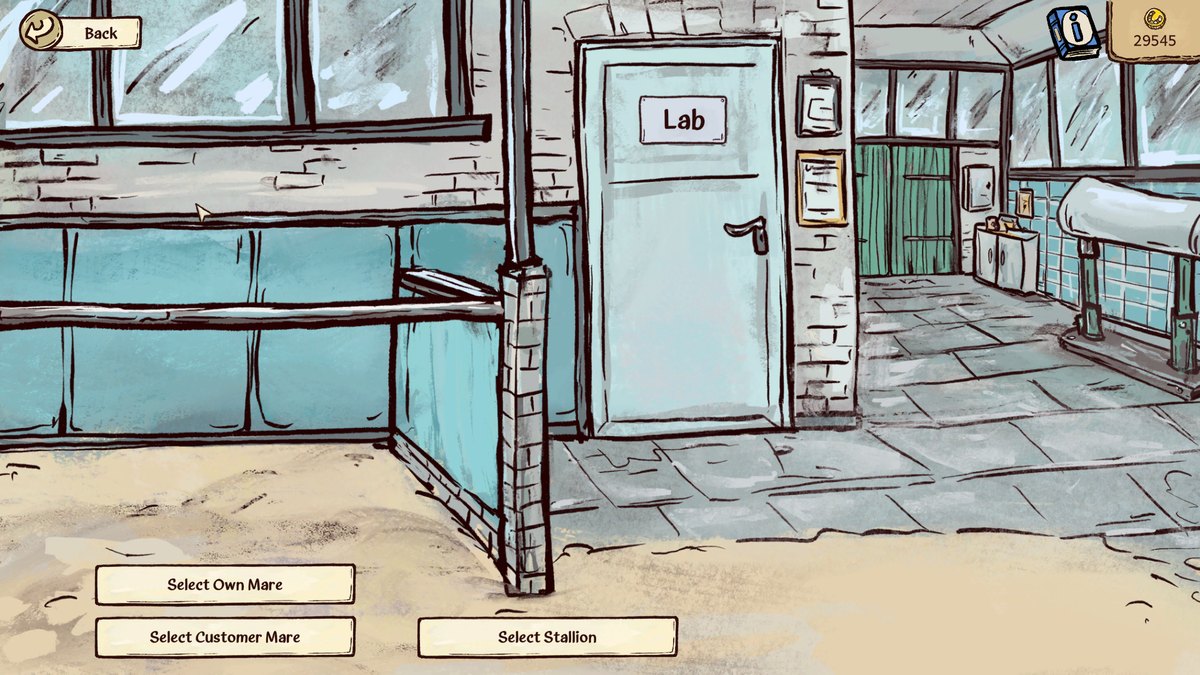
The Lab door opens at stage 2. Inside are the Foal Simulator and the Semen Bank.
Checking if she took
Insemination can fail, and the game shows the same “was inseminated” message either way. Open the mare’s medical report to find out. If it worked, it names the sire and her due day.
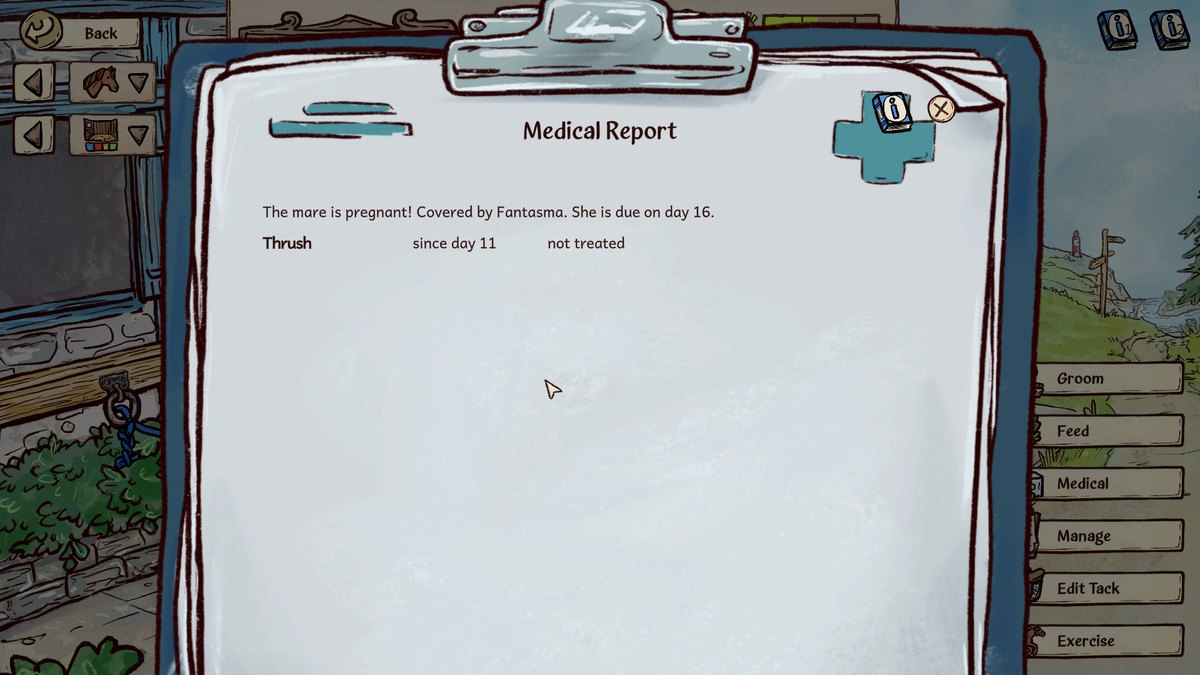
The vet has no pregnancy test, so there’s no need to look for one.
A failed attempt still costs the fee and the semen, and it uses up the mare’s breeding for that day.
Keep stallions away from your mares
A mare that shares a stable group with a stallion can get pregnant by herself. Every new day, each stallion in her group has a 25% chance of covering her. Closing the fields doesn’t stop it, and a mare can get pregnant this way while she’s nursing or injured.
This catches a lot of new yards out, because the Stable starts with a single group of 4 horses. Buy a stallion at that stage and every adult mare you own is at risk from day one. Upgrade the Stable to stage 2 for 2,500 coins first, which gives you two groups, and keep stallions in one and mares in the other.
Mixing groups costs you in other ways as well:
- Boarders: if a boarder’s mare gets pregnant, the owner collects her and you pay a 500 coin penalty.
- Stallion fights: two or more stallions in a group with a mare will fight. Each one has a 50% chance of getting a cut every day, and that carries on after the mare is pregnant. A boarder’s stallion getting hurt costs you 200 coins.
- Colts: a young stallion counts from 13 days old. When he grows up he moves to whichever group has space, which might be his mother’s. Move him out before that, or call the vet to geld him for 120 coins. Geldings are always safe.
Picking the parents
A foal’s strength potential and endurance potential are rolled separately. Each one is the parents’ average plus a random amount, and that amount depends on how closely related they are.
| Parents | Added to the average |
|---|---|
| Unrelated | -4 to +11 |
| Half-siblings, or grandparent and grandchild | -8 to +7 |
| Full siblings, or parent and child | -12 to +3 |
Each parent with Good Inheritance moves that range up by 2, and each with Bad Inheritance moves it down by 2. The Traits and Quirks guide covers how those work.
So unrelated parents gain 3.5 potential per generation on average. That’s why breeding within your own herd stalls: a foal of half-siblings averages a tiny loss, and closer relatives lose ground. Bring in an unrelated stud every time you can, which the town breeder makes easy.
Strength potential can’t go below 25, endurance potential can’t go below 20, and neither can go above 100. Three quests reward high foals: 50 in both, 75 in both, and 100 in both. The Breeding Calculator shows your exact odds for any pair.
The Foal Simulator
Pick a mare and a stallion in the Lab to see the foal’s potential range and their coefficient of relatedness. Simulate Foals also shows a sample of how the foals could look. Run it before you pay for anything.
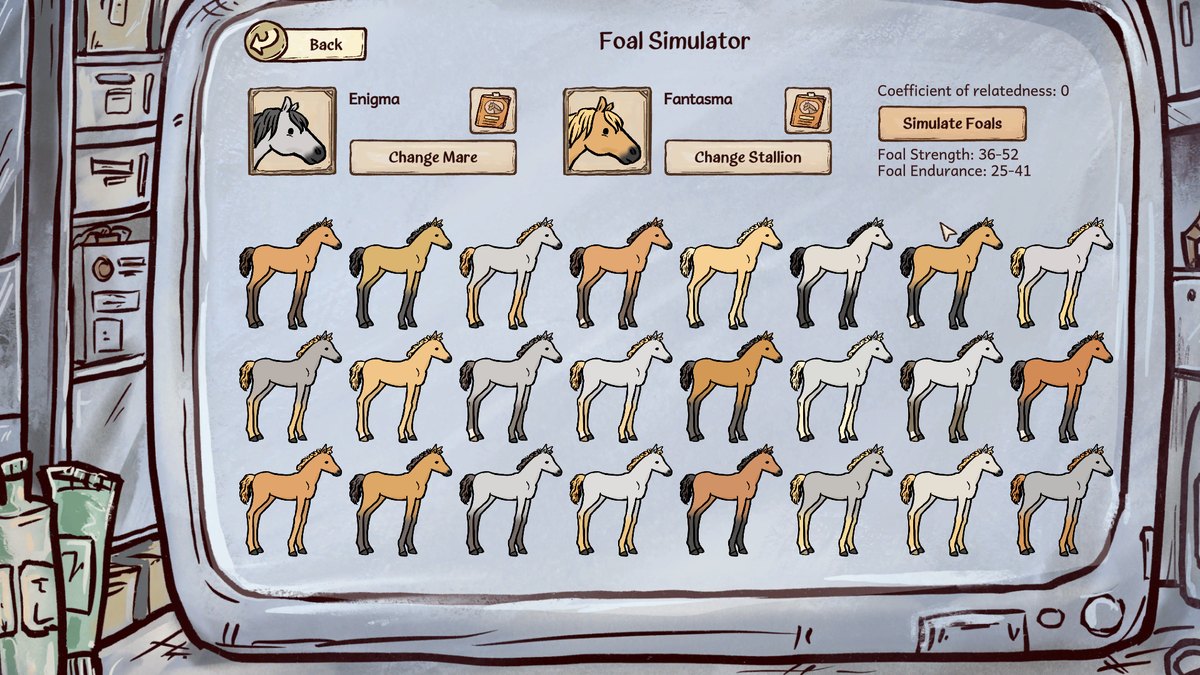
The top number is 1 higher than a foal can actually roll. It’s also the free way to learn a horse’s real potential, because the Simulator works from true values. With no known Inheritance traits on either parent, the top number minus 12 is their true average.
The range only counts traits you’ve discovered, so a hidden Bad Inheritance won’t show up in it. A 200 coin vet test tells you first. The potential the game shows for a horse is also a guess: the true number sits somewhere inside the range it gives you. Test Potential gives you the exact figure for 150 coins.
Looks and confidence
A foal has a 50% chance of being a mare or a stallion. Body colour comes from one parent and mane colour from one parent, picked separately, with a slight shift lighter or darker.
Each kind of marking also comes from one parent. Leg whites, head markings, tobiano, roan and appaloosa are each picked as a set, so a plain parent can wipe out a marking if the foal happens to take after them.
Raise the mare’s Confidence before you cover her. A foal starts with half of her Confidence on the day she’s covered, and whatever she gains afterwards doesn’t help it. Every foal starts at 10 strength and endurance, or 15 with a Good Mom, who also adds 5 Confidence.
Pregnancy, day by day
Count from the day she’s covered. Her due day is in her medical report.
| Day | What happens |
|---|---|
| 0 | She’s covered. The foal’s potential and Confidence are already set |
| 1 to 3 | She works as normal |
| 4 | She can’t be ridden any more |
| 8 | The foal is born, and she can be covered again |
| 11 | You’re warned if there’s no space for the foal |
| 12 | The foal becomes a yearling and she’s back to normal |
| 20 | The yearling becomes an adult |
From day 4 to day 12 she needs some extra care.
Feed her grain. She loses 15 extra body condition every day of that stretch, and one feed of grain adds 25, so it more than covers the loss. A mare who starts at 0 on hay alone turns hungry on day 8, right as the foal arrives. Keep her hay rack full as well, because a night without hay costs her 35.
Keep her moving. She can still lunge and walk while she’s heavily pregnant, using any lunging course, Leading, Forest Walk, and Beachside Stroll and Mountain Hike once you’ve unlocked those trails. Once the foal arrives she’s limited to Leading, Confidence Training and those three walks, so lunging is out. None of these train strength or endurance, but they matter for two reasons:
- She can still turn Explosive if she gets too little exercise.
- Horses lose strength and endurance once they’ve gone over 2 days without training, up to 5 of each a day, down to a floor of 10. Exercising her that day halves her loss.
Here’s what that adds up to if you train her on day 3. Leave her idle and she loses 27 strength and 27 endurance by day 12. Walk her every day and she loses 11. Plan a retraining block before you take her back to competitions.
Raising foals
A foal stays with its mother for 4 days, then moves out as a yearling. It needs a place to go.
| Yearling Paddock stage | Cost | Running cost per day | Space |
|---|---|---|---|
| 1 | 5,000 | 20 | 6 yearlings |
| 2 | 10,000 | 100 | 13 yearlings |
Without a paddock, a yearling takes a spot in the stables. If there’s no room at all, it gets boarded at the breeder in town for 100 coins a day until you make space. The same happens when a paddock yearling grows up with no free stall, since adults can’t stay in the paddock.
Yearlings can’t be ridden until they turn 12 days old, but you can lunge and walk them.
Selling a pregnant or nursing mare sells the foal with her, and her price only goes up by part of the foal’s value.
Selling stud services
A stallion’s semen value is 50 coins plus a share of his potential and prize money. Customers pay that plus a little extra depending on what they buy:
| Sale | You get | Limit |
|---|---|---|
| Cover a customer’s mare | Semen value + 50 | One a day per stallion |
| Fresh semen | Semen value + 10 | 4 to 6 portions a day |
| Frozen semen | Semen value + 20 | Whatever you’ve frozen |
The Semen Bank in the Lab lists your prices. The box shows what you have stored, and the speech bubble shows how many customers are asking.
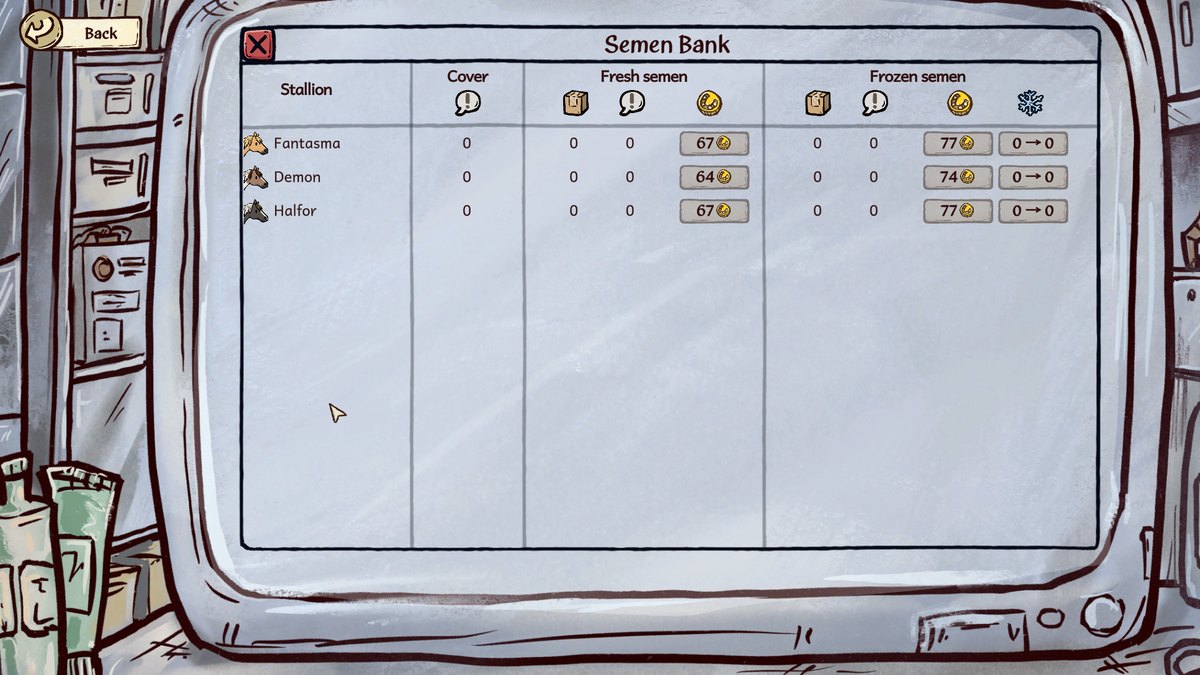
Each stallion can do one job a day: cover a mare or take semen. Taking semen is usually worth more if you have the requests, since one collection fills several orders. Fresh semen expires at the end of the day, so only collect what you can use.
Frozen semen keeps forever, but each stallion freezes differently. Depending on him, you get about a quarter to all of the fresh portions back as frozen ones.
Requests come from fame. A stallion gets more of them as he reaches higher riding levels and wins prize money, and your prestige multiplies that. An untested stallion gets almost none, so compete with him first.